
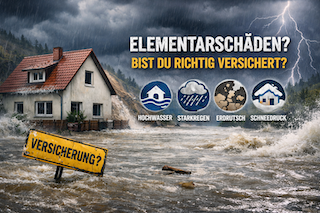
Buildings Insurance — Natural Hazards
(in the truest sense of the word: elemental)Heavy rain, floods and other natural events are becoming more and more frequent in Germany. As a result, the damage is increasing — and with it the costs for insurers, policyholders and ultimately for all of us. That is why there is currently intensive discussion about how protection against natural hazard damage can be organised in future so that it is affordable and makes sense for everyone.
What is behind it?
Today, natural hazard cover is usually just an additional module to residential buildings insurance. As a result, many buildings are not insured at all or only to a limited extent. After major loss events, the state often steps in with aid payments — a solution that is not really sustainable in the long term.
Which ideas are currently being discussed?
In politics and the insurance industry, two approaches in particular are on the table: ✒Solidarity-based models, in which all owners pay a small additional contribution so that buildings in particularly exposed locations can also be insured at an affordable price. ✒Regulatory solutions, for example automatic inclusion of natural hazard cover with the option of actively deselecting it ("opt-out") or — discussed less often — compulsory cover.
The common aim of these approaches is to avoid sharp premium increases, to spread risks more widely and to make insurance cover more stable overall.
What does this mean for your premiums?
Regardless of political decisions, the following already applies today: More frequent damage and rising repair costs lead to premium adjustments. This trend is likely to continue in the long term. Models with solidarity-based elements are intended to help make costs more predictable and to spread them more evenly.
Our conclusion for you:
Adequate natural hazard cover will become increasingly important in future. At the same time, it is worth keeping an eye on developments and regularly reviewing your own insurance cover — both the benefits and the premiums.
We'll be happy to discuss with you ✒what your current insurance cover looks like, ✒which risks are relevant for you and ✒how you can set yourself up sensibly and with the future in mind.
Talk to us at any time — we will continue to keep you up to date on important developments.
here is some further reading on this exciting topic
also read on versicherungsmagazin.de
also read on mwu.sachsen-anhalt.de
also read on vzbv.de
also read on allianz.de
also read on merkur.de
FAQ – Natural hazard damage & insurance cover
What exactly is natural hazard damage?
This means damage caused by natural events – for example floods, heavy rain, inundation, sewage backflow, landslides, earthquakes, snow load or avalanches. Important for you: this damage is not automatically included in residential buildings insurance.
Am I automatically insured against natural hazard damage?
No. Natural hazard cover is usually an additional module that you have to actively include. As a result, many buildings are currently not covered at all or only partially covered.
Why are premiums for natural hazard cover becoming more expensive?
There are several reasons: ✒Storms and heavy rain occur more frequently and more intensely ✒Damage has become significantly more expensive due to higher construction and material costs ✒Insurers have to build up larger reserves to cover major loss events ✒These developments have a long-term effect on premiums.
What is meant by a "solidarity-based model"?
With such models, all owners would pay a small additional contribution so that buildings in particularly exposed locations remain insurable at an affordable price. The aim is to distribute costs more fairly and to avoid extreme premium increases for individuals.
Is compulsory insurance for natural hazard damage coming?
There is currently no compulsory insurance. However, various solutions are being discussed politically – for example automatic cover that you would have to actively deselect ("opt-out"). Whether and when anything will change here is still open.
What happens if I don't have natural hazard cover?
Then you will generally have to pay for damage caused by floods or heavy rain yourself. State aid is voluntary, not guaranteed and does not replace reliable insurance cover.
Do I need natural hazard cover even in supposedly safe areas?
Yes. Heavy rain in particular can occur anywhere, including outside traditional flood areas. Much of the damage now occurs precisely where nobody would have expected it before.
Can I do anything myself to keep premiums under control?
Yes, for example through: ✒a suitable deductible ✒preventive measures such as backflow valves ✒regular review of your insurance cover ✒timely adjustments – not just after a loss
Our recommendation for you
We recommend that you review your insurance cover regularly: ✒What specific risks are there for your building? ✒Is natural hazard cover already included, or would it make sense? ✒Does your cover still match current developments?
How do you stay up to date?
We keep an eye on developments in the market and in politics for you and will inform you as soon as anything important changes. If you have any questions or would like a personal assessment, feel free to contact us at any time.
this text was read on online pages and a summary was created with AI (Copilot/ChatGPT)