
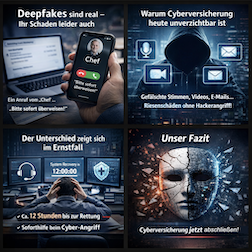
Deepfakes: the new reality of fraud – and why cyber insurance is indispensable today
A call from the boss. The voice sounds exactly the same as always. The instruction: an urgent bank transfer. What sounded like science fiction just a few years ago is everyday reality today: deepfakes and AI-assisted deception are now among the biggest cyber risks – for businesses and private individuals alike.
As insurance brokers, we see every day how rapidly cybercrime is evolving. Traditional protective measures are often no longer enough. Up-to-date cyber insurance is therefore not a “nice-to-have” but an essential building block of risk protection.
What are deepfakes – and why are they so dangerous?
Deepfakes use artificial intelligence to imitate voices, videos or entire identities in a deceptively realistic way. Cybercriminals use this technology specifically for:
- CEO fraud (fake instructions from managing directors)
- Manipulated video or voice messages
- Forged payment and contract approvals
- Social engineering attacks without malware
The crucial point:👉 The attack does not necessarily come through the IT systems, but through people.
This is exactly where many traditional cyber policies reach their limits.
Good news: modern cyber insurance is responding to deepfakes
The specialist cyber underwriting agency Stoïk has specifically adapted its policy wording to this new threat situation. Deepfakes and AI-assisted deception are explicitly named as insured losses – particularly in the area of fraud and deception.
Source: IT‑Finanzmagazin
Important for policyholders:
- Deepfakes are no longer considered a “grey area”
- AI-based fraud scenarios are explicitly covered
- Losses without a classic system hack can also be covered
The real added value of cyber insurance: help when it matters
Today, cyber insurance means much more than just reimbursing costs.
Example Stoïk:
- On average only about 12 hours to get a business up and running again after a cyber attack
- Immediate access to cyber experts, forensic specialists and incident response teams
- Crisis management from a single source – technical, legal and organisational
Especially with deepfake attacks, every hour counts. Payment flows must be stopped, communication managed and trust restored.
Why this is also relevant for private customers
Cyber insurance is often associated only with businesses – wrongly so.
Private customers are affected by:
- AI-based scam calls
- Identity misuse
- Fake video or voice messages among family or friends
- Social media account takeovers
The financial and emotional damage can be considerable.
👉 Cyber risks don't stop at the factory gate.
For whom is cyber insurance indispensable today?
- ✅ Businesses of all sizes
- ✅ Self-employed & freelancers
- ✅ Managing directors & decision-makers
- ✅ Private individuals with a digital everyday life
- ✅ Families with online banking & social media
The question is no longer whether an attack will happen – but when and how well prepared you are.
Our conclusion as insurance brokers
Deepfakes mark a turning point in cybercrime:
- Highly realistic
- Quickly scalable
- Hardly recognisable for humans
Modern cyber insurance such as that from Stoïk takes this reality into account and combines insurance cover with active support in the event of a claim.
👉 Those who act today protect themselves against the existential risks of tomorrow.
Interested in individual cyber advice?
Together we will check:
- Your specific risks
- The right cover for private or business customers
- Sensible prevention measures
Talk to us – before a fake turns into real damage.
this text was read on online pages and summarised with AI (Copilot/ChatGPT)